
“Most articles lump all summer rashes as ‘heat rash’. There are actually five distinct types — and treating the wrong one delays healing by weeks.”— Dermatology Practice Notes
What This Article Has That Top Pages Don’t
• Five distinct summer rashes — most articles only describe heat rash properly.
• 30% of people living in warm climates get heat rash; up to 9% of newborns get it in their first weeks.
• Bedding swap (cotton-only, no synthetic blends) prevents many recurring cases.
• Tight swaddling makes newborn heat rash dramatically worse.
• 30-second self-check distinguishes heat rash from allergic reaction by timing and texture.
First, Some Skin Biology
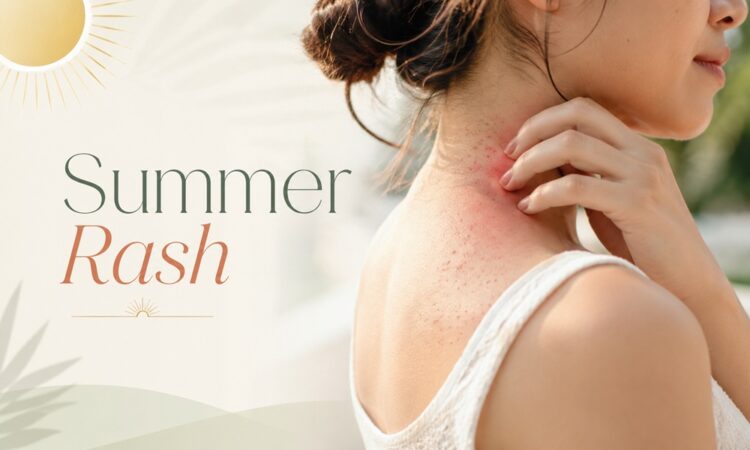
Your skin has 2–4 million sweat glands. When humidity is high and you’re sweating constantly, these glands can clog. Trapped sweat irritates the skin from below. Heat, friction, and bacteria do the rest.
But heat rash is only one of five common summer skin conditions. They look similar at a glance — different treatments. Get the identification right and most clear up in days.
The Identification Guide — Find Yours Below
Pattern A: Tiny clear water-like bumps, no itch
Likely: Miliaria Crystallina — the mildest form of heat rash.
Typical location: Face, neck, chest, shoulders.
Looks like: Small, clear, fluid-filled blisters that break easily. Almost dewdrop appearance.
Treatment: Cool down. Resolves in 24 hours without any cream needed. Keep the skin dry.
Pattern B: Red bumps + intense itching + prickling sensation
Likely: Miliaria Rubra — classic ‘prickly heat’.
Typical location: Skin folds, back, chest, groin, where clothes rub.
Looks like: Small red inflamed bumps in clusters. May feel like pinpricks or burning.
Treatment: Calamine lotion, cool showers, loose cotton clothes. Hydrocortisone 1% cream for severe itching in adults. Avoid heavy moisturisers.
Pattern C: Firm flesh-coloured bumps, often painful, deep in skin
Likely: Miliaria Profunda — deep heat rash, rarer.
Typical location: Trunk, arms, legs.
Looks like: Firm bumps that resemble goose bumps, sometimes painful or itchy. May break open.
Treatment: See a dermatologist. Stop all sweating for several days. May need prescription creams.
Pattern D: Itchy red patches/hives appearing hours after sun
Likely: Polymorphic Light Eruption (sun rash).
Typical location: Chest, V of neck, arms — areas first exposed after winter.
Looks like: Itchy red patches, raised welts, or small blisters. Worse 4–8 hours after sun exposure, not immediately.
Treatment: Avoid sun while it heals, SPF 50+, cool compresses, oral antihistamines. Severe cases need a doctor.
Pattern E: Red ring-shaped scaly patches spreading outward
Likely: Fungal infection (Tinea — ringworm, jock itch).
Typical location: Groin, underarms, between toes, under breasts.
Looks like: Red scaly border with clearer centre. Slowly spreads outward. Intensely itchy.
Treatment: Antifungal cream (clotrimazole, miconazole) for 2–4 weeks. Keep area dry. Don’t share towels.
Quick Diagnostic Table
| Symptom Pattern | Likely Type | First Action |
| Tiny clear blisters, no itch | Miliaria crystallina | Cool down, no cream |
| Red bumps, intense itch | Prickly heat | Calamine + loose cotton |
| Deep firm bumps, painful | Miliaria profunda | See dermatologist |
| Patches after sun, delayed | Sun rash (PLE) | Avoid sun + antihistamine |
| Ring-shape, spreading | Fungal infection | Antifungal cream |
| Hives, immediate | Allergic reaction | Antihistamine, find trigger |
Heat Rash vs Allergic Reaction — The 30-Second Test
| HEAT RASH
• Develops hours after sweating • Bumpy or prickly texture • Mostly in sweat zones and skin folds • Clears in days when skin is cooled • Itch is prickly, mild to moderate • No swelling beyond the rash itself |
ALLERGIC REACTION
• Develops minutes after contact • Raised welts (hives), smooth • Can appear anywhere, even unexposed • Comes and goes with allergen exposure • Itch often intense • May swell — face/lips swelling is urgent |
The Home Treatment Routine (For Heat Rash)
- Cool the skin — tepid (not cold) shower for 10 minutes.
- Pat dry, never rub.
- Apply calamine lotion or aloe vera gel — thin layer only.
- Wear loose 100% cotton. Skip synthetic for at least a week.
- Switch bedsheets to cotton; ditch sweat-trapping sheets.
- Run AC or fan in the bedroom — sweat-free skin is the only real cure.
- Avoid scented soaps, talcum powder, and oily moisturisers.
Prevention That Actually Works
- Cotton clothes — both day and night, especially nightwear
- Two short showers instead of one long one
- Antiperspirant on dry, clean skin (not over fresh sweat)
- Avoid heavy creams in summer; use light gels
- Don’t bundle infants — 30% of newborn rash is from over-swaddling
- AC at night even at moderate temperatures helps the skin heal
- Stay in shade between 11 AM – 4 PM during heatwaves
Summer Skin-Friendly Daily Routine
| Time | What to Do |
| Morning | Cool shower with mild soap. Pat dry. Light aloe gel on affected areas. |
| Day | Reapply sunscreen every 3 hours. Avoid tight clothing on rash zones. |
| After sweat | Wash sweaty zones with cool water within 30 minutes. |
| Evening | Second tepid shower. Allow skin to air-dry for 5 minutes before dressing. |
| Night | Cotton sleepwear, light cotton sheets, AC/fan running. |
Common Mistakes That Make Summer Rash Worse
- Applying thick creams that trap sweat (use light gels)
- Using hot water in the shower (heat irritates more)
- Scratching — breaks skin and invites infection
- Using powders heavily — clogs sweat ducts further
- Wearing synthetic fabrics that don’t breathe
- Skipping sunscreen because of the rash (you still need it)
| See a Doctor If…
The rash spreads rapidly, oozes pus, comes with fever, doesn’t clear in 5 days, or affects a baby’s face severely. These could signal infection or another skin condition needing prescription treatment. For severe sun rash, prescription steroid creams may be needed. |
Quick FAQ
Q: Why does heat rash come back every year?
A: Recurrence usually means a recurring trigger — synthetic clothing, sweaty bedding, certain creams. Once identified and changed, most people see major improvement.
Q: Can babies use the same heat rash treatments as adults?
A: No. Skip hydrocortisone cream on babies without a paediatrician’s say-so. Calamine lotion and cooling the room are safe. See a doctor for severe baby heat rash.
Q: Is talcum powder good for prickly heat?
A: In small amounts, dusted lightly, it can help. Used heavily, it clogs the sweat ducts further. Many dermatologists now prefer light cooling gels over powder.